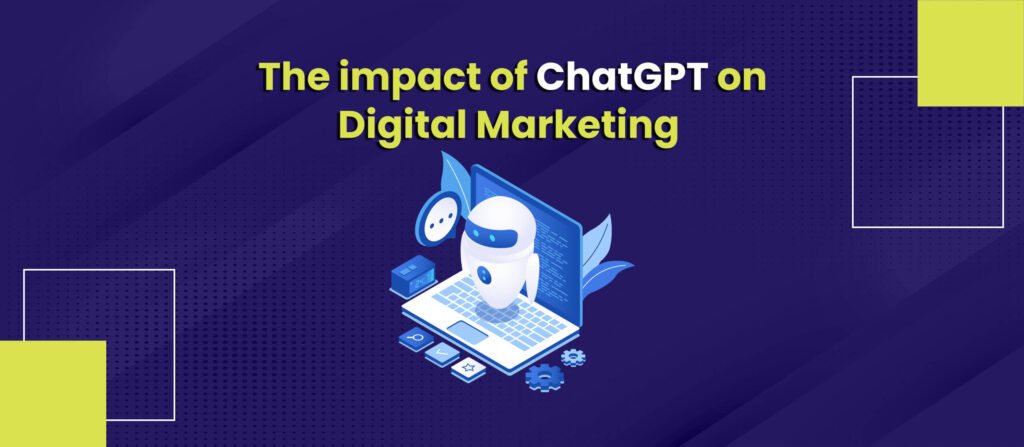
Digital marketing has evolved rapidly over the past decade — but nothing has transformed it quite like ChatGPT. Powered by advanced AI from OpenAI, ChatGPT has reshaped how brands create content, engage customers, analyze data, and scale campaigns.
In 2026, it’s no longer just a writing assistant — it’s a full-scale marketing engine. Let’s explore how ChatGPT is changing digital marketing forever.
What is ChatGPT and How does it work?
- ChatGPT is an advanced language model developed by OpenAI that utilizes generative AI and natural language processing (NLP) techniques to engage in human-like conversations. It is trained on vast amounts of text data, enabling it to generate coherent and contextually relevant responses.
- The journey of ChatGPT began with its predecessor, GPT-3, which gained immense popularity for its ability to generate high-quality text. Building upon the success of GPT-3, OpenAI developed ChatGPT with a focus on improving conversational capabilities and fine-tuning it for practical applications.
- ChatGPT operates by processing input text and generating responses based on the context provided. It uses deep learning techniques, specifically a neural network architecture called a transformer, which enables it to understand and generate human-like language.
- ChatGPT finds applications in various domains, including customer service, content creation, and personalized marketing. Its ability to understand and generate natural language makes it a valuable tool for engaging with customers, creating tailored content, and providing automated assistance.
ChatGPT in Digital Marketing!
- With its advanced language generation capabilities, ChatGPT presents exciting possibilities for digital marketers. It can be used to create engaging content, provide personalized responses, and automate customer interactions. Incorporating ChatGPT into digital marketing strategies can enhance customer engagement, improve lead generation, and streamline marketing operations.
- In conclusion, ChatGPT has emerged as a game-changer in the realm of digital marketing. Its ability to generate natural language and engage in meaningful conversations opens up new avenues for businesses to connect with their audience and optimize their marketing efforts. By harnessing the power of ChatGPT, digital marketers can unlock innovative ways to drive customer engagement, deliver personalized experiences, and stay ahead in the dynamic digital landscape.
✍️ 1. Content Creation at Lightning Speed
Content is king 👑 — but creating high-quality content consistently used to take hours (or days).
With ChatGPT, marketers can now:
- Generate blog posts in minutes 📝
- Write SEO-optimized product descriptions 🛍️
- Create engaging social media captions 📱
- Draft email campaigns 💌
- Develop ad copy that converts 🎯
This dramatically reduces production time while maintaining creativity and consistency.
Impact: Faster campaigns, lower content costs, and scalable content strategies.
🔎 2. SEO Strategy & Optimization
Search engine optimization (SEO) is essential for online visibility. ChatGPT helps marketers:
- Discover keyword ideas
- Optimize meta descriptions
- Create structured outlines
- Improve readability
- Answer search intent accurately
It doesn’t replace tools like SEMrush or Ahrefs, but it enhances them by turning raw data into optimized, search-friendly content.
Impact: Higher rankings, better engagement, and more organic traffic. 📈
🤝 3. Smarter Customer Engagement
ChatGPT powers:
- AI chatbots
- Automated replies
- 24/7 customer support
- Personalized responses
Brands can now respond instantly without sacrificing personalization.
This improves:
- Customer satisfaction 😊
- Conversion rates 💰
- Brand loyalty ❤️
AI-driven conversations feel increasingly human — and customers appreciate quick, helpful responses.
📊 4. Data Analysis & Insights
Digital marketing generates massive amounts of data. ChatGPT helps interpret:
- Campaign performance
- Audience behavior
- Email engagement
- Conversion trends
Instead of manually analyzing spreadsheets, marketers can simply ask for insights.
Impact: Faster decision-making and smarter marketing strategies. 🧠
🎯 5. Personalized Marketing at Scale
Personalization used to require heavy manual segmentation. Now, AI enables:
- Personalized email sequences
- Dynamic ad copy
- Custom product recommendations
- Audience-specific messaging
Combined with ad platforms like Meta and Google, ChatGPT helps tailor messaging for different audience segments.
Impact: Higher engagement and improved ROI. 💡
📱 6. Social Media Strategy Enhancement
From brainstorming viral ideas to writing captions and scripts, ChatGPT helps marketers stay consistent across platforms like:
- TikTok
It can also:
- Repurpose long-form content into short posts
- Suggest trending hooks
- Create content calendars
Impact: Better engagement with less creative burnout. 🔥
💰 7. Cost Reduction for Businesses
Hiring full marketing teams can be expensive. ChatGPT supports:
- Small businesses 🏪
- Startups 🚀
- Solopreneurs 💼
By handling writing, brainstorming, and basic analytics, it reduces dependency on large teams — without sacrificing quality.
Impact: More affordable marketing for businesses of all sizes.
⚡ 8. Faster Campaign Execution
Time-to-market is crucial in digital marketing. ChatGPT enables:
- Quick campaign drafts
- Rapid A/B testing ideas
- Instant headline variations
- Faster funnel creation
Speed creates competitive advantage. 🏁
🌍 The Bigger Picture: AI + Human Creativity
While ChatGPT is powerful, it works best when combined with human creativity and strategy.
It can:
✔️ Generate ideas
✔️ Improve efficiency
✔️ Automate repetitive tasks
But marketers still provide:
🎨 Brand voice
🧩 Strategy
💬 Emotional intelligence
🎯 Final decision-making
The future of digital marketing isn’t AI vs. humans — it’s AI with humans.
🔮 Final Thoughts
ChatGPT has fundamentally changed digital marketing in 2026. It empowers marketers to work faster, smarter, and more creatively than ever before.
Businesses that adopt AI strategically gain:
- Higher efficiency
- Better personalization
- Stronger customer engagement
- Increased profitability 📈
The question is no longer “Should we use AI?”