In an era when almost everything we do happens online — work, entertainment, banking, shopping — privacy and security have become major concerns. Many people turn to tools like VPNs and proxies to protect themselves, but there’s often confusion about what each one actually does and which is better for your needs.
In this blog, we’ll break down the differences between VPNs and proxies, explore their strengths and limitations, and help you decide which one suits you best.
🧠 What Is a Proxy?
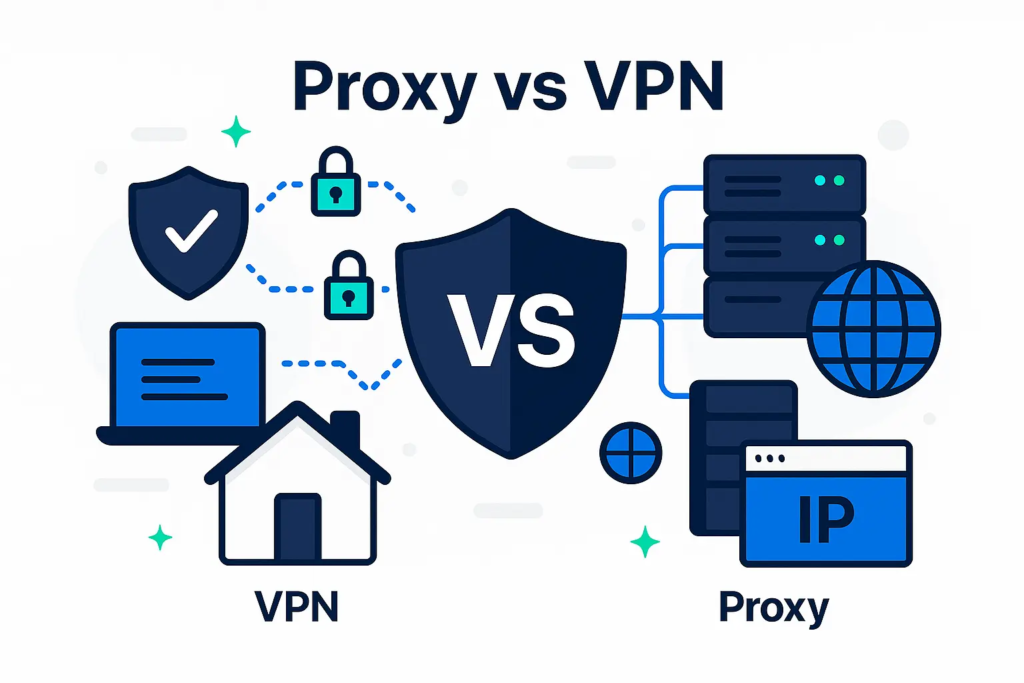
A proxy server acts as an intermediary between your device and the internet. When you use a proxy, your internet requests are routed through that server, which can:
- Hide your IP address from the websites you visit
- Bypass simple regional restrictions
- Cache content to speed up browsing
Think of a proxy as a middleman that stands between you and the web — but only for specific applications (like a browser or certain software).
✔️ Pros of Using a Proxy
- Simple to set up
- Often free
- Can help access geo-blocked websites
- Works for specific applications (like a browser)
❌ Cons of Using a Proxy
- Doesn’t encrypt your traffic
- Not secure for sensitive data
- Only affects traffic from configured apps
- Many free proxies are unreliable or unsafe
Use case: Bypassing regional restrictions in a web browser — but not for sensitive or secure online activity.
🛡️ What Is a VPN?
A Virtual Private Network (VPN) creates a secure, encrypted tunnel between your device and a remote server. All your internet traffic — including apps, games, streaming, and background services — travels through this encrypted tunnel.
✔️ Pros of Using a VPN
- Encrypts all traffic on your device
- Hides your IP and location
- Works with all apps and services
- Enhances online security and privacy
- Good for public Wi-Fi protection
❌ Cons of Using a VPN
- Can slow down internet speed slightly
- More complex than a simple proxy
- Requires a subscription for quality services
Use case: Protecting sensitive data, securing online banking, streaming geo-restricted content safely, and browsing with privacy.
🔍 VPN vs Proxy: Side-by-Side Comparison
| Feature | VPN | Proxy |
|---|---|---|
| Hides your IP | ✅ Yes | ✅ Yes |
| Encrypts traffic | ✅ Yes | ❌ No |
| Works for all apps | ✅ Yes | ❌ Only configured apps |
| Speed impact | ⚠️ Slight reduction | ✅ Minimal |
| Ideal for streaming | ✅ Yes | ⚠️ Limited |
| Ideal for privacy/security | ✅ Excellent | ❌ Poor |
| Free options available | ⚠️ Limited (often premium) | ✅ Many free |
🕵️♂️ When Should You Use a Proxy?
A proxy might be enough if:
- You just want to bypass simple geo-blocks
- You’re using a public or shared device
- You don’t need strong privacy protections
Examples:
- Watching a region-restricted video in your browser
- Accessing a website blocked on a local network
But remember: A proxy does not protect your data, passwords, or private messages.
🛡️ When Should You Use a VPN?
A VPN is the better choice if you care about:
- Security and privacy
- Online banking and sensitive transactions
- Protecting all your internet traffic
- Using public Wi-Fi safely
Examples:
- Logging into your bank account on public Wi-Fi
- Streaming content that’s geo-restricted
- Working remotely with confidential data
In nearly all serious situations, a VPN provides far more protection than a proxy.
🧠 Final Thoughts: Which Is Better?
The short answer: A VPN is almost always better than a proxy for privacy, security, and overall protection.
A proxy can be useful for simple browsing tasks and occasional access to blocked websites, but it does not encrypt your traffic and offers minimal security.
A VPN, on the other hand, encrypts all your traffic and protects your data across all apps and services — making it the smart choice if you care about privacy or safety online.
👉 Tip: If your priority is security and data protection — especially on public networks or when handling sensitive information — choose a VPN. If you just need occasional access to region-specific content from a browser, a proxy might be enough.